The PERFECT 2 Day Kyoto Itinerary: Hidden Gems & Highlights
I’ve visited Kyoto twice now, and I’ll be be honest—two days is barely enough time to scratch the surface of this sprawling and endlessly enchanting city.
But its still enough time to hike the thousands of vermillion torii gates up Mt. Inari, wander through the winding streets of Gion, watch the sunset over the city at Kiyomizu-dera, journey through the mountains on a traditional boat down the Hozugawa River, explore hidden zen temples and bamboo groves in Arashiyama, dine at local izakayas, and walk along the lantern-lit Pontocho Alley.
This 2 day Kyoto itinerary includes all of that and more, based on my most recent trip to Kyoto. We had the choice to spend only two days in Kyoto or skip it altogether, and we chose two days. I’m so glad we did, and I hope my Kyoto itinerary helps you plan an equally memorable Japan trip!


🎟️ Reservations to make in advance:
- 🎋 Day 1: Hidden Fushimi Inrai Hiking Tour (or the Private Tour Option if you’re visiting with a family/group)
- 🛶 Day 2: Hozugawa River Boat at 11am (earlier if you can skip breakfast or grab something to-go)
You may also want to add-on: Tea Ceremony in Kimonos, Samurai Experience, Hidden Kyoto E-Bike Tour, or Night Tour of Gion
Where to Stay in Kyoto
If you only have two days in Kyoto like we did, I’d highly recommend staying somewhere central—specifically somewhere around Kyoto station or downtown.
I say this becuase we did not stay in those areas—we stayed in a beautiful, charming residential area of Higashiyama. It was a lovely area, but we lost a bit of precious time walking, riding the bus and train, and even calling taxis because its not very well connected. I’d stay in that area again if I had more time, but for two days, it wasn’t ideal (though we were absolutely spoiled with the best vegan breakfast daily!)
If I were visiting again, these are the Kyoto hotels I’d consider staying at:
- Kyoto Takasegawa Bettei: Beautiful traditional hotel with a luxury ryokan feel, but more affordable. It’s a 13-minute walk from Kyoto Station, so it’s incredibly convenient!
- Ala Hotel Kyoto: Clean, modern hotel a few blocks from Kyoto Station with a big onsen and rooms go for as low as $97/night!
- Good Nature Kyoto: A nature-focused modern hotel in the heart of downtown Kyoto, with all the amenities you could think of! It is centrally located, but a few miles from Kyoto Station.
Also See: Where to Stay in Kyoto for First Timers: Central & Charming


Day 1: Fushimi Inari, Gion & Kiyomizu-dera at Sunset
Hidden Fushimi Inari Hike
📍 Start: Tofukuji Station | 3 minute train ride (1 stop) from Kyoto Station
There’s no better way to start off your Kyoto adventures than by hiking beneath the thousands of red torii gates that lead up Mt. Inari.
But instead of getting lost in the crowds at the main entrance (this is one of the most visited shrines in Japan), hike up beneath the uncrowded torii-lined trails that locals use!


We did this by joining this local-led hiking tour of Fushimi Inari, although we could have tried to find the hidden trails on our own, there are a few reasons why this $70 tour was worth every penny:
- We hiked all the way to the summit of Mt. Inari (with a view of the city below) via the back way with dozens of crowd-free photo ops amongst the torii gates, but still got to see the main part of Fushimi Inari Shrine at the end
- We learned so much more about the shrine than we ever would have on our own—the shrine’s origin story, who donates the red torii gates (and why), the significance of the numerous smaller shrines throughout the mountain, and so much more
- Before we made it to Fushimi Inari, our guide met us right outside Tofukuji Station (one stop from Kyoto Station), then guided us through a local neighborhood (so cute) and through Tofuku-ji Temple, a stunning Buddhist temple I would have missed on my own
Best of all, our guide, Louis, was genuinely one of the best tour guides I’ve ever had. He’s a university student and pro photographer from nearby Nagano whose passion for Kyoto really shines through! We learned so much more about Fushimi Inari and Kyoto on this tour than we did on any other tour in Japan—and of course, got to experience a side of the mountain that most tourists miss.
Check out my 10 Day Japan itinerary to see how we fit Kyoto in!
Vermillion Café
📍 Pin: Vermillion Café | 3 minute walk from Fushimi Inari Shrine
After saying goodbye to our lovely guide at Fushimi Inari Taisha, we walked a few minutes over to Vermillion Café, a tranquil cafe overlooking a tiny pond!
I’d forgotten to charge my camera the night before (and took waaaay too many pictures at Fushimi Inari) and then it died right as I was trying to snap a picture here at Vermillion Cafe, but a quick Google shows you how beautiful this place is!
We ordered some delicious coffee, vegan pasties, and a granola bowl for a little pick-me-up before heading onto our next adventure for the day.


Gion & Higashiyama
📍 Start: Local Sake & Beer Stand 336 | 15 minute taxi ride from Fushimi Inari Shrine, or 25 minutes via bus and walking
Located within the larger Higashiyama district, Gion is Kyoto’s historic geisha district, home to winding streets lined with traditional wooden homes.
You’ll see plenty of ladies dressed up in kimonos, and may even spot a real geisha if you know what you’re looking for (join this Gion night tour to learn about + spot geishas).
The best thing to do here is simply wander with a few interesting stops pinned on your map, our pinned spots included:
- 🍶 Local Sake & Beer Stand 336 (our FAVORITE): A welcome break from the busy streets to take a variety of local sake (and beer) here. I didn’t think I was a sake person but these delicious herbal brews won me over!
- 📷 Hōkan-ji Temple (Yasaka Pagoda): Seeing this stunning 5-story pagoda rise over the streets of Gion is one of the best things to do in Gion!
- 👘 Walk along the prettiest streets: Ninenzaka, Sannenzaka, Hanamikoji, Miyagawasuji, and Shirakawa
- 🛍️ Visit artisan shops: Despite how touristy this area is, most of the shops are still small, locally-owned artisanal shops, like Musahi Knife Shop. We also enjoyed shopping at Donguri Kyowakoku, the official Studio Ghibli shop!
- 🍵 Attend a tea ceremony: Prebook this tea ceremony, which takes places in the most beautiful garden, right in the heart of Gion! We walked by and wished we’d have made a reservation when we saw how serene it is!
Keep in mind, Gion is one of those areas you simply must see, but expect the streets to be quite crowded. Lots of travel bloggers will tell you to show up at sunrise to beat the crowds, but some of us can’t be bothered to get up that early on vacation!


Sunset at Kiyomizu-dera
📍 Start: Nio-mon Gate | 8 minute walk from Local Sake & Beer Stand
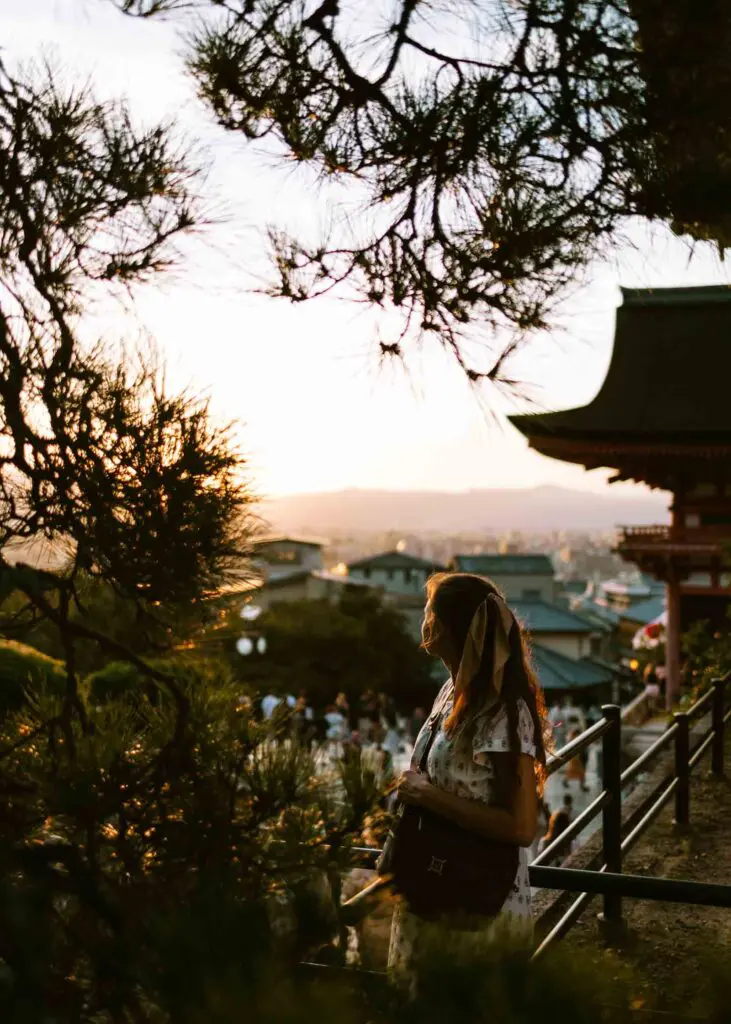
Next, walk up the hill toward the Kiyomizu-dera, a 1200-year-old Buddhist temple perched on a cliff overlooking the city of Kyoto. It’s the perfect place to watch the sunset, but there’s plenty to see here, so I’d arrive at least an hour before sunset to give yourself time to explore the temple grounds.
As you approach Kiyomizu-dera Temple from the streets of Gion below, you’re first greeted with the towering vermillion Nio-mon Gate (where we snapped the photo above). Then pass a few pagodas and other temple structures before you have to pay the ¥500 entry fee.
From there, you can walk along the Kiyomizu-dera ‘stage’ floor which extends out of the cliff, held up by 43-foot-long wooden silts. Walk further for a view of the temple with Kyoto in the background (best spot for watching the sunset!)
And if you walk even further, there are short trails through the gardens to explore, with Otowa-no-taki Falls, Koyasu-no-to Pagoda, and a Shinto shrine inside.
🍲 Dinner Options in Gion: There are no shortage of excellent places to eat dinner in Gion! If you need some ideas, head to Gion Tanto for okonomiyaki cooked right in front of you, Masaichi for authentic seasonal set menus, or Silver Back’s, where we had the best home cooked vegan food of our entire Japan trip!


Day 2: Hozugawa River Adventure, Arashiyama Moss Temples & Pontocho Alley

Hozugawa River Boat Ride
📍 Start: Kameoka Station | 28 minute train ride from Kyoto Station
After taking the San-In JR line east through the rolling Arashiyama mountains, board a traditional wooden boat navigated by three hilarious (and seriously strong) boatmen with bamboo poles. Kind of like a gondola ride in Venice, except you journey through the mountains before arriving in tranquil Arashiyama.
And while the scenic 2-hour boat ride itself was exceptional, I honestly think the best part was stepping onto land in Arashiyama, feeling like we were arriving in a completely different era! (Arashiyama does have that old-Japan-feel, but more about what to do in Arashiyama next!)
For the boat ride, you’ll need to make a reservation in advance on Klook. We chose the 11am slot to leave plenty of room for our hotel’s breakfast, but if you can just grab food at a convenience store, I’d book an earlier slot. Keep in mind the boat launch area is about a 7-minute walk from the Kameoka train station.
We were put on an ‘English-speaking’ boat with three goofy boatmen who spoke basic English—enough to keep us all laughing with their jokes throughout the whole boat ride. We weren’t bored for a moment!
As we approached Arashiyama our boat was greeted with a vendor boat selling cold soda, beer, and teriyaki mochi! It was my first time trying savory mochi, which was a much needed snack before we headed into Arashiyama for lunch.
🍱 Lunch in Arashiyama: There are lots of places to eat in Arashiyama, all a short walk from where you get off the boat. If I could do it again, I’d make a reservation for Shoraian where you can enjoy a traditional set lunch while overlooking the river. For a sweet treat, head to Enman Rice Cake Restaurant for yummy mochi.


Temples & Trails of Arashiyama
📍 Start: Togetsukyō Bridge | Walking distance from boat
As with many of the popular places in Kyoto, the main part of Arashiyama gets quite crowded. But there are so many quieter streets and enchanting temples and shrines just a short distance away.
We started by taking a taxi up Saga Toriimoto Preserved Street, then walking back down and stopping at temples, shrines, and other hidden gems on the way. Bring some cash as some of the small temples only take cash.
If it is open, start at Otagi Nenbutsuji Temple, known for its thousands of little statues covered in moss. This temple was the #1 thing I wanted to see in Arashiyama, but our plans got switched around last minute and we ended up visiting on a day when the temple was closed—I was HEARTBROKEN, so please visit for me!! (It is closed on Wednesday and Saturday).


The next temple (where we started since Otagi Nenbutsuji was sadly closed) is Adashino Nenbutsuji Temple, an 8-minute walk away. The 1200-year-old temple is home to 8,000 stone grave markers and a small (uncrowded) bamboo grove.
From there, keep walking down the charming Saga Toriimoto Preserved Street and optionally stop at Saga Toriimoto Tea and Coffee Hijiri for a warm drink on the way down. There are dozens of other little temples in this area, but our sights were set on Giōji Temple, a modest temple surrounded by dense moss gardens and maple trees!
After Giōji Temple we headed toward the grand Tenryu-ji Temple, Arashiyama’s main temple, which is right next to the famous Arashiyama Bamboo Forest. But before we reached it, we walked by Ogura Pond, a small but picturesque lotus pond that felt like it was straight out of My Neighbor Totoro.


Arashiyama Bamboo Forest is free to visit, with a short pathway through that leads to Tenryu-ji Temple. It was insanely crowded, and underwhelming (especially after seeing the less crowded bamboo forests on our hidden Fushimi Inari hiking tour and at Adashino Nenbutsuji Temple).
Tenryu-ji Temple, on the other hand, exceeded my expectations! The site was home to Japan’s first zen temple, Danrin-ji, later became a residence for emperors, and the current temple was established in 1339. My favorite parts were the tranquil Sogenchi Teien (pond garden) and viewpoint over the temple on the small hill above.
When you’re done in Arashiyama, you can catch the San-In JR Line back to Kyoto station, or another line to wherever you’re staying in Kyoto!
For a more in-depth outline of my Arashiyama recommendations, see How to Spend One Day in Arashiyama, Kyoto.


Dinner & Drinks at Pontocho Alley
📍 Start: Pontocho Park | 20 minute bus from Kyoto Station
Spend your last night in Kyoto at an izakaya along (or nearby) the lantern-lit Pontocho Alley. Okay, but before we get too excited, I have heard that most of the eateries actually in the alleyway are overrated.
We throughly enjoyed walking through the alleyway (and snapping a few photos) after dark, but ate at the exceptional plant-based izakaya Nijiya, which is only a block away. If you’re unfamiliar, an izakaya is a tiny Japanese bar and dining at one is a must-do Japan experience!
You can usually order a variety of small plates, which allows you to try a lot of different dishes! At Nijiya we indulged in some delicious vegan yakitori, miso rice balls, dumplings, freshly made tofu, obanzi and local sake!
Pontocho Alley is close to the river, which is a lovely place to walk along in the evening. It’s also right on the edge of downtown Kyoto, so there’s tons of shops to peruse around. We also visited Beer Pub Ichi-Ya to try some Japanese beers (my husband’s favorite).
More Japan Travel Guides
- What You NEED to Book in Advance for Japan (And How)
- How to Spend One Day in Arashiyama, Kyoto
- Where to Stay in Kyoto for First Timers: Central & Charming
- The Perfect 3 Day Tokyo Itinerary: Traditional & Modern
- 7 Charming Ryokans & Unique Hotels in Asakusa, Tokyo
- 11 Tokyo Hidden Gems for Exploring off the Beaten Path
- A First Timer’s Guide to the Hozugawa River Cruise in Kyoto
Save for later on Pinterest:


I was so overwhelmed when it came to planning Kyoto because it has so many nice temples, gardens and things to see. Thank you for putting this itinerary together because it helped me so much in eliminating things from the intinerary and really focusing on my top sights I wanna see 🙂
Vanessa, thanks so much for your comment! I’m so glad my itinerary helped you plan your trip – that’s my goal and it’s so good to hear! Enjoy Kyoto and anywhere else you head in Japan!!